
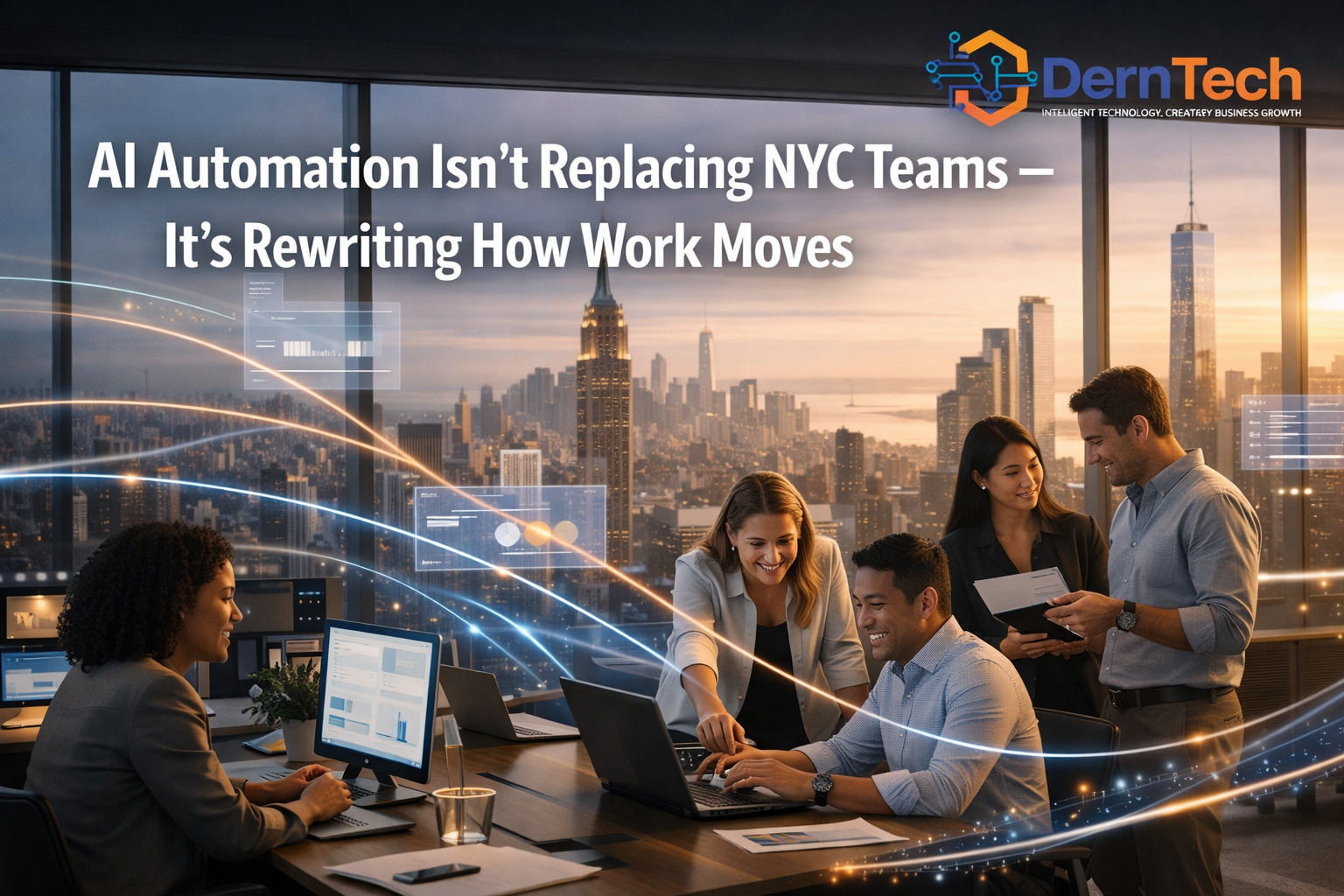
There’s a quiet misunderstanding spreading through boardrooms and Slack channels alike: that AI automation is here to replace people. In New York, that idea doesn’t survive contact with reality.
NYC has always been a city where work moves fast, expectations are high, and competition leaves little room for inefficiency. In this environment, AI automation isn’t eliminating teams. It’s doing something far more powerful. It’s changing how work flows, how decisions are made, and how human effort is spent.
The companies winning right now aren’t using automation to cut headcount. They’re using it to remove friction. And that distinction matters more than most people realize.
Why the “Replacement” Narrative Is Wrong
The idea that automation replaces teams comes from an outdated view of how work actually happens. Most modern roles aren’t defined by one task. They’re defined by context, judgment, creativity, and communication.
What slows teams down isn’t lack of effort. It’s repetition. Manual handoffs. Disconnected systems. Time spent moving information instead of acting on it.
AI automation addresses those problems, not people.
In New York, where labor is expensive and speed is a competitive advantage, businesses quickly learn that removing waste is far more valuable than removing talent. This is why adoption is accelerating across industries from marketing and finance to logistics and professional services.
Automation Changes the Direction of Work, Not the Workforce
The real impact of AI automation is directional. It changes where human energy goes.
Instead of teams spending hours on reporting, data entry, follow-ups, or manual coordination, those processes are handled automatically. The human role shifts upward, toward strategy, creativity, and decision-making.
This is why companies that invest in business automation often see improved morale alongside productivity gains. People stop feeling busy and start feeling effective. In NYC, where burnout is common and retention matters, this shift has become a strategic advantage.
The Rise of Automation as Infrastructure
One of the biggest changes happening right now is how automation is viewed inside organizations. It’s no longer treated as a tool or experiment. It’s becoming infrastructure.
Just as cloud computing quietly changed how systems are built, automation is changing how work is structured. Tasks flow between systems without manual intervention. Information moves in real time. Decisions are supported instantly.
This is where AI automation services differ from basic scripting or one-off tools. The focus isn’t on automating a single task. It’s on designing intelligent workflows that adapt as the business grows.
NYC companies that understand this are building long-term operational leverage, not short-term efficiency.
How Marketing Teams Are Leading the Shift
Marketing is often the first department where automation shows its true value. Not because marketing is simple but because it’s complex.
Campaigns touch multiple platforms. Data comes from everywhere. Timing matters. Manual coordination becomes a bottleneck fast.
This is why automated marketing has become one of the fastest-growing applications of AI automation in New York. When done correctly, it doesn’t remove marketers from the process. It removes the chaos around them.
Automation handles segmentation, scheduling, lead routing, and performance tracking. Humans focus on messaging, strategy, and creative direction. The result is faster execution without sacrificing quality.
This is also why more NYC companies are partnering with a specialized automation agency instead of trying to stitch tools together internally.
Small Businesses Are Gaining the Most
One of the most overlooked realities of AI automation is its impact on small and mid-sized businesses.
In the past, operational sophistication was reserved for large enterprises. Smaller teams had to compensate with longer hours and manual effort. That gap is closing rapidly.
With the right automation strategy, a small business can now operate with the efficiency of a much larger organization. Follow-ups happen automatically. Leads are nurtured intelligently. Operations stay consistent even during growth.
This is why marketing automation for small businesses is gaining traction in NYC. Not as a luxury, but as a survival strategy in competitive markets.
Why Automation Fails When It’s Done Wrong
Not all automation succeeds. In fact, many early attempts fail quietly.
The reason is simple: automation layered on top of broken processes only accelerates confusion. When workflows aren’t understood, automating them creates more problems, not fewer.
This is where experienced marketing automation companies and AI specialists add real value. They don’t start with tools. They start with understanding how work actually moves inside a business. The most successful automation initiatives begin with clarity. Once processes are visible, automation enhances them rather than distorting them.
Automation Is Becoming a Leadership Decision
What’s changing in NYC right now is who drives automation decisions.
Initially, automation was seen as a technical initiative. Today, it’s increasingly owned by leadership. Founders, CMOs, and operations heads are shaping automation strategies because they see the broader impact.
Automation affects customer experience, employee satisfaction, and scalability. It determines how quickly a business can adapt to change. These are leadership concerns, not technical details.
This shift is why choosing the right Ai automation agency has become a strategic decision, not a procurement task.
AI Automation and the Human Advantage
There’s a misconception that automation makes work colder or less human. In reality, the opposite is happening.
By removing repetitive tasks, automation gives people more time to think, communicate, and create. Customer interactions become more meaningful. Internal collaboration improves. Decisions are informed rather than reactive.
In New York’s service-driven economy, this human advantage matters. Businesses aren’t competing on price alone. They’re competing on experience, responsiveness, and trust.
Automation supports those goals when it’s designed around people, not just systems.
Real-World Example: How Automation Changes a Marketing Team’s Day-to-Day Work
Consider a mid-sized New York marketing agency managing campaigns for multiple clients. Before automation, the team’s day is fragmented. Data is pulled manually from ad platforms. Leads are exported, cleaned, and uploaded into CRM systems. Follow-up emails are sent late, or not at all, because timing depends on human availability.
After implementing AI-driven automation, the work itself doesn’t disappear but its movement changes.
- Campaign performance data updates automatically in real time
- Leads are routed instantly based on intent and behavior
- Follow-up sequences trigger without manual intervention
The team no longer spends mornings preparing reports. Instead, they spend that time analyzing results and refining strategy. Automation didn’t replace the team it removed the drag that kept them reactive.
This is the practical impact of automated marketing when it’s implemented with intention rather than hype.
The Future of Work Is Already Here
What many companies call “the future of work” is already operational in forward-thinking NYC businesses.
Work moves differently now. It flows through intelligent systems. It adapts in real time. It supports people instead of overwhelming them. AI automation isn’t a trend waiting to arrive. It’s a capability being built right now by companies that understand its real purpose.
They aren’t replacing teams. They’re redesigning how work moves through their organization.
A New Standard for Competitive Advantage
In a city where time is scarce and competition is relentless, efficiency alone is not enough. What matters is intelligent momentum.
Businesses that embrace automation strategically create systems that compound value. Each improvement makes the next one easier. Each workflow becomes smarter over time.
This is why AI automation is no longer optional for NYC companies with growth ambitions. It’s becoming a baseline expectation.
Final Thought
The most successful automation initiatives share one trait: they respect human work.
They don’t aim to eliminate people. They aim to remove obstacles. They don’t chase hype. They solve real problems.
In New York, where work never slows down, AI automation isn’t rewriting jobs. It’s rewriting how work moves quietly, intelligently, and permanently and the businesses that understand this shift today will define the competitive landscape tomorrow.